The Decision That Shapes Everything Else About Your Wrap
Once you have decided to wrap your vehicle, the conversation almost immediately turns to color. What shade of blue, which tone of green, whether to go for something bold or understated. But before color, there is a more fundamental decision that shapes how every color will ultimately look on your car — and it is one that many first-time wrap buyers do not think about carefully enough until after the job is done.
That decision is finish type: gloss, satin, or matte. These three options are not simply different levels of shine. They are genuinely different aesthetic experiences, different maintenance commitments, and different long-term outcomes for how your vehicle looks and how much work it takes to keep looking that way. A color you love in gloss can look completely different in satin — sometimes better, sometimes not — and the same is true for matte. Choosing the finish before you choose the color, not after, is the approach that produces the most satisfying result.
This guide breaks down all three finishes honestly and completely. By the end, you will have a clear framework for making the right choice for your specific vehicle, your lifestyle, and the aesthetic you are genuinely after — rather than making the most common mistake in wrap buying, which is choosing a finish based on what looks best on someone else’s car without considering whether it works for yours.
Gloss Wrap: High Impact and Maximum Reflectivity
Gloss is the closest a vinyl wrap comes to replicating the look of a factory paint job. A quality gloss wrap produces a deep, wet-looking surface that reflects light sharply and dramatically — showing clouds, buildings, and surroundings in the surface the way a polished mirror does. It is the finish type that reads as most immediately premium at a distance, and it is by far the most popular choice for drivers who want their vehicle to look expensive and well-maintained in the conventional sense of the word.
The visual character of gloss
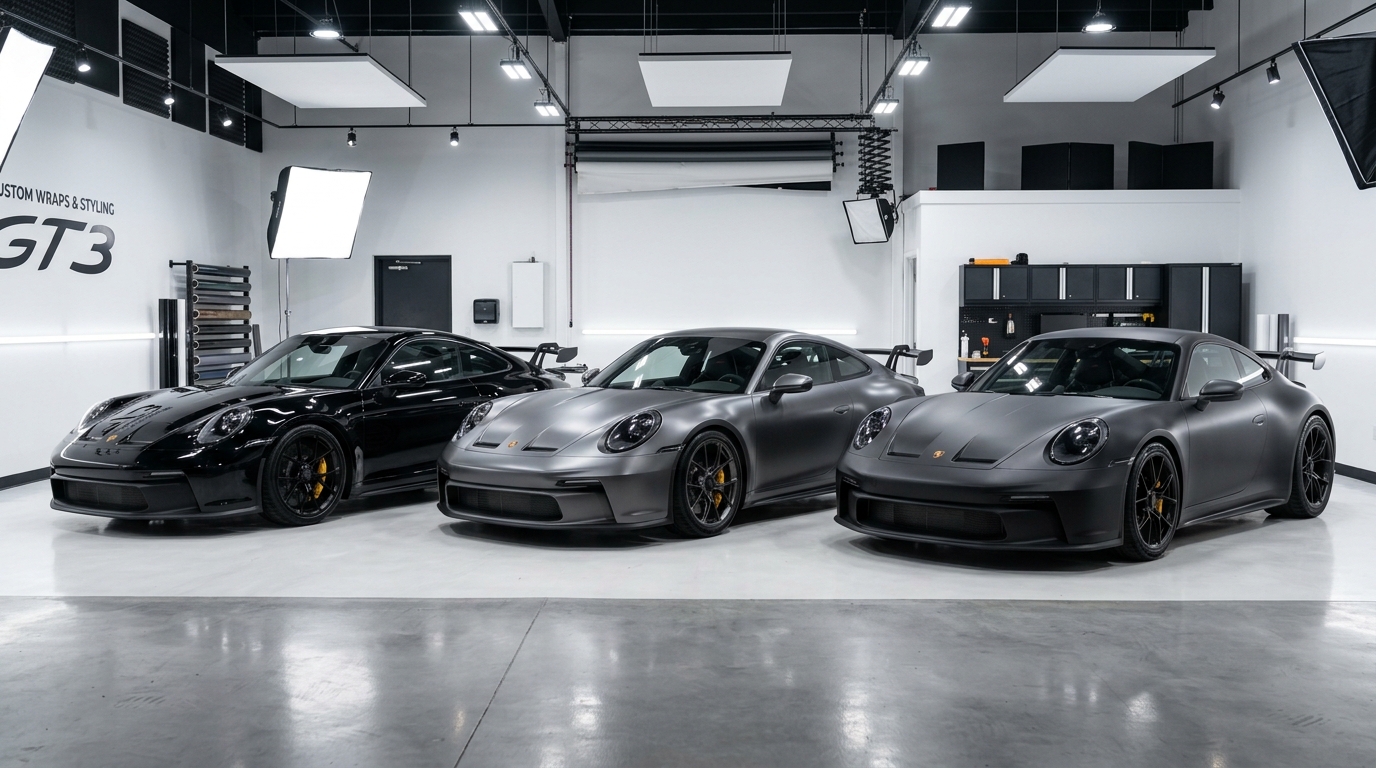
The defining quality of gloss is reflectivity. Light sources — the sun, streetlights, showroom lighting — reflect clearly off the surface and appear as distinct highlights that move across the car as the viewing angle changes. This dynamic quality gives gloss-wrapped vehicles a visual energy and presence that matte and satin do not produce in the same way. Under overcast skies, gloss still reads as a rich, saturated color. Under direct sunlight, it becomes genuinely striking. At car meets and in photographs, gloss consistently delivers the most dramatic result.
Colors that work best in gloss
Almost any color translates well into gloss, but the finish delivers its best results in deep, saturated hues — gloss black, gloss navy, gloss forest green, gloss candy red, and gloss metallic silver are all outstanding choices that fully exploit the reflective surface. Light colors such as gloss white and gloss pearl also perform extremely well, with a clean, paint-like quality that passes as factory finish remarkably convincingly. As Edmunds confirms in its comprehensive car wrap guide, gloss vinyl is the most common wrap finish choice, with full-vehicle gloss wraps on standard-sized vehicles typically ranging between $2,000 and $5,000 depending on vehicle size and complexity — making it a competitive alternative to a quality respray at any color.
The trade-off: surface sensitivity
Gloss comes with one meaningful practical trade-off: it shows everything. Water spots, fingerprints, fine swirl marks from washing, and bird dropping etch marks are all more visible on a gloss surface than on satin or matte. Gloss-wrapped vehicles require more frequent attention to maintain their best appearance — regular washing, prompt removal of contaminants, and ideally a ceramic coating applied over the top to reduce water spotting and make cleaning easier. For drivers who wash their car weekly or park primarily indoors, this is not a significant burden. For drivers who want a finish that looks clean with less effort, gloss is the most demanding of the three options.

Matte Wrap: Bold, Modern, and Deliberately Understated
Matte is the finish that turned the automotive customization world on its head when it became widely available through the aftermarket wrap market. Before matte vinyl, achieving a non-reflective paint finish required expensive specialist paint application and significant ongoing maintenance. Matte vinyl made the look accessible, affordable, and — crucially — reversible. The result was one of the most significant shifts in automotive aesthetic culture in the last two decades, and matte has remained a genuinely influential finish choice rather than a trend that faded.
The visual character of matte
Where gloss reflects light sharply and clearly, matte scatters it — absorbing light rather than bouncing it back. The result is a surface that appears completely flat, with no visible highlights, no reflections of surroundings, and a consistent, even color depth across the entire panel regardless of the viewing angle. This flatness creates a dramatically different reading of the vehicle’s body lines — it strips away the visual complexity that reflections create and lets the car’s shape speak entirely for itself. On vehicles with strong, sculptural body lines, matte amplifies those lines rather than distracting from them. On simpler body designs, it creates a graphic, high-contrast aesthetic that reads as deliberately minimal rather than merely plain.
Colors that work best in matte
Matte is most powerful in dark, neutral, or military-inspired colors. Matte black is the most iconic application — aggressive, monolithic, and immediately purposeful-looking. Matte charcoal, matte gunmetal, matte army green, and matte dark bronze all leverage the flat finish’s unique ability to make colors feel heavier, more tactile, and more dimensional than they appear in any other finish. Lighter matte colors — matte white, matte light grey, matte beige — work well in specific aesthetic contexts, particularly on European-influenced builds where the palette runs lighter and the overall design language is understated rather than aggressive.
The trade-off: maintenance demands
Matte vinyl requires specific maintenance that differs meaningfully from gloss or satin care. Standard car waxes and gloss-enhancing sealants cannot be used on matte surfaces — they fill the micro-texture of the flat finish and create glossy patches that ruin the uniform appearance. Matte-specific cleaning products must be used for every wash, and waterless or rinseless wash methods are often preferred to avoid dragging fine contaminants across the sensitive surface. Pressure washer use requires careful technique — high-pressure water directed at panel edges can lift adhesion over time. For drivers willing to learn and follow the specific maintenance protocol, matte vinyl lasts well and repays the care with a finish that looks genuinely distinctive years into ownership.
Satin Wrap: The Middle Ground Everyone Is Talking About
Satin is the finish that has seen the most significant growth in the wrap market over the last three years, and the reason is straightforward: it solves the trade-offs of both gloss and matte without fully giving up either of their advantages. Satin sits exactly between the two — producing a low-gloss, silk-like surface that reflects light softly rather than sharply, without reaching the full flatness of a true matte finish.
The visual character of satin
The defining quality of satin is what industry professionals sometimes call “depth without shine.” The surface catches light and produces a subtle, diffused luminosity — a warm glow rather than a sharp highlight. It reads as premium and deliberate from any distance, without the maintenance sensitivity of full gloss or the strict care requirements of full matte. In person, a well-applied satin wrap has a quality that photographs struggle to fully capture — it appears almost tactile, like the surface of brushed silk or a luxury product finish. This quality is one reason satin has become the default choice for prestige vehicle wraps, commercial fleet branding, and any application where the goal is to look expensive rather than flashy.

Colors that work best in satin
Satin performs well across a remarkably wide color range. Satin black is a natural starting point — producing a finish that is instantly distinguishable from both gloss black and matte black, and that many drivers consider the most elegant of the three. Satin dark grey, satin midnight blue, and satin deep green are all outstanding choices that leverage the finish’s characteristic depth. Satin metallics — particularly satin silver, satin brushed titanium, and satin champagne gold — deliver a finish that comes closer to genuine brushed metal than almost any other vinyl option, making them ideal for both full-vehicle wraps and panel accent applications. If you have been exploring iridescent or color-shifting options and want something that changes visually under different lighting without the full intensity of a chameleon film, a satin metallic is worth considering — our guide to iridescent and chameleon wrap finishes covers the more dramatic end of the dynamic-finish spectrum for context.
The practical advantages
From a maintenance perspective, satin is the most forgiving of the three finishes. It does not show water spots and fingerprints as readily as gloss, and it does not require the strict specialized care protocol that matte demands. Standard automotive shampoos work well on satin surfaces, pressure washing is safe with normal technique, and light contamination — bird droppings, tree sap, road grime — is easier to remove cleanly than on matte without leaving marks. For drivers who want a distinctive finish that works with a normal washing routine, satin consistently delivers the best practical outcome.
Maintenance: What Each Finish Requires
Understanding the maintenance difference between the three finishes before committing is one of the most important practical steps in choosing correctly. The finish that looks best in the shop is not always the finish that is easiest to keep looking its best on the road.
Gloss maintenance
Wash regularly using pH-neutral automotive shampoo and a soft microfiber mitt. Remove contaminants — bird droppings, insect residue, tree sap — promptly rather than leaving them to etch the surface. A ceramic coating applied over gloss vinyl adds hydrophobic protection that dramatically reduces water spotting and makes routine cleaning faster and more effective. Our guide to maintaining your vehicle’s paint protection coating covers the ceramic coating care principles that apply equally to coated gloss vinyl surfaces.
Matte maintenance
Use only matte-specific cleaning products — never standard wax, polish, or gloss sealant. Waterless or rinseless wash methods are preferred where possible. For contamination removal, use a dedicated matte-safe decontamination spray rather than physical scrubbing, which can create glossy rub marks on the flat surface. Avoid automated brush car washes entirely — they abrade the matte surface consistently and irreversibly over repeated use. A matte-safe ceramic coating is available and is strongly recommended for matte wraps on vehicles that are daily driven and exposed to significant environmental contamination.
Satin maintenance
Standard automotive shampoo and a microfiber wash mitt work well on satin surfaces. Avoid high-gloss waxes and spray polishes, which can alter the satin sheen slightly. Pressure washing is safe with standard technique. Satin-safe spray sealants are available and provide a degree of hydrophobic protection that makes ongoing maintenance easier. Of the three finishes, satin requires the least adjustment from a standard car-washing routine — making it genuinely the most practical choice for drivers who want a premium-looking finish without a premium-complexity maintenance schedule.
Choosing the Right Finish for Your Vehicle
The right finish comes down to three overlapping factors: the vehicle’s body design, the color you are considering, and your honest assessment of how much time and specific care you are willing to invest in ongoing maintenance.
Match the finish to the vehicle’s character
Gloss suits vehicles that are already visually complex — aggressive body lines, aerodynamic details, sculpted surfaces — because it amplifies that complexity through reflections and highlights. Matte suits vehicles with strong, graphic silhouettes and clean panel surfaces, where the flat finish lets the shape dominate. Satin suits almost any vehicle, but performs particularly well on luxury or European body designs where the goal is sophistication over aggression.
Consider the color alongside the finish
Before finalizing a finish type, look at your chosen color in all three finishes if possible — the same color can shift significantly in character between gloss, satin, and matte. A forest green that reads as rich and painterly in gloss can read as military and utilitarian in matte. A burgundy that looks classic in gloss can look almost purple in matte depending on the specific pigment. Seeing physical samples in your actual lighting conditions — not just on a screen — is the most reliable way to make this decision confidently. Our team at ASC can walk you through physical samples and help you visualize the combinations that will work best for your specific vehicle. Explore the full range of exterior styling options and related services on our trim and upholstery page, or take a look at how contrasting finish panels can be used creatively in our guide to panoramic roof wraps and contrasting panel effects.
Be honest about your maintenance commitment
If you wash your car every week and enjoy the detailing process, gloss is a realistic and rewarding choice. If you want a distinctive finish that stays looking good with a normal bi-weekly wash routine and no specialist products, satin is your strongest option. If you are specifically drawn to matte — its character is genuinely unique and worth pursuing — go in with clear knowledge of its specific care requirements and commit to them from day one. A matte wrap that is cared for correctly is one of the most striking finishes in the automotive world. One that is not maintained correctly loses its character relatively quickly and is more difficult to restore than either gloss or satin.
Whatever finish direction you choose, the quality of the vinyl film and the skill of the installer have as much impact on the long-term result as the finish type itself. For a closer look at how textured and specialty finishes expand the possibilities even further beyond the core gloss/satin/matte spectrum, our guide to textured vinyl wraps in brushed metal, carbon fiber, and leather finishes covers the next layer of options available to drivers who want to go further. Get in touch with the ASC team to discuss which finish direction is right for your vehicle and start planning your wrap transformation with confidence.