Why BC Drivers Get This Wrong More Often Than They Should
Walk into almost any auto parts store in British Columbia and you will find tint films on the shelf. Watch enough YouTube tutorials and you will find plenty of confidence-building guides suggesting that tinting your own windows is a straightforward weekend project. What those tutorials rarely cover — and what many professional tint installers see the consequences of regularly — is the legal framework that governs what you can actually apply to which window on a vehicle registered and driven in BC.
British Columbia has some of the strictest window tint regulations in Canada, and the rules are more nuanced than a single darkness percentage applied uniformly across all windows. The front side windows are governed by a strict VLT minimum. The windshield has a specific restriction many drivers are surprised by. The rear windows operate under a completely different set of rules from the front. And the critical — and most commonly misunderstood — detail is that BC’s legal standard measures the combined VLT of both the film and the existing factory glass together, not the film in isolation.
Getting this right matters practically. Fines for non-compliant tint in BC can reach $598, ICBC inspections can trigger removal orders, and a tint job that passes visual inspection today can fail a tint meter test at a traffic stop tomorrow. This guide gives you the complete, accurate picture of what BC law actually requires — window by window — so you can make an informed decision before booking your installation.
Understanding VLT: The Number That Governs Everything
Every window tint regulation in BC — and across Canada — is expressed in terms of VLT, or Visible Light Transmission. VLT is a percentage that describes how much visible light passes through the combined glass and film layer. A higher VLT percentage means a lighter, less dark window. A lower VLT percentage means a darker, more private window.
How the percentages translate in practice
A 70% VLT window allows 70% of visible light to pass through — it is almost clear, with only a subtle reduction in light that is barely noticeable in most conditions. A 35% VLT window allows 35% of visible light through — visibly darker, with meaningful privacy in daylight conditions but still transparent enough for others to see movement inside the vehicle. A 20% VLT window — common on rear windows — allows only 20% of light through, producing a deeply private appearance from outside while maintaining reasonable visibility from inside the vehicle in daylight.
Why the film rating and the installed VLT are different numbers
This is the detail that catches the most drivers out. When a tint film is rated at 70% VLT, that rating describes how much light the film alone passes. It does not account for the factory glass it will be applied to. Most modern vehicle front windows have factory glass with a VLT of approximately 75 to 85%. When a 70% VLT film is applied over 78% factory glass, the combined VLT is approximately 55% — well below BC’s legal minimum for front side windows. BC law measures the installed result, not the film specification. This means that even a very light-looking film can create a non-compliant result when stacked on top of already-tinted factory glass, and a reputable professional installer will calculate combined VLT for your specific vehicle before any film is cut.
The BC Rules Window by Window
British Columbia regulates window tinting under Section 7.05 of the Motor Vehicle Act Regulations, Division 7 — Other Equipment. The rules differ significantly by window position, and understanding each position individually is the only way to approach a tint installation correctly. As the BC-specific summary at Tinting Laws Canada notes, citing the Motor Vehicle Act Regulations directly, the province applies different standards to each window position rather than a single uniform rule across the whole vehicle.
Front side windows: 70% VLT minimum
The driver’s side and front passenger side windows have the strictest requirement: the combined VLT of the installed film and the factory glass must be at least 70%. This leaves very little room for any meaningful darkening on most vehicles — given that factory glass already sits at 75 to 85% VLT, adding almost any aftermarket tint film will bring the combined total below 70% unless the film itself is essentially clear. In practical terms, the only aftermarket film that can legally be applied to BC front side windows without risking a VLT violation is a clear or near-clear UV-blocking film — one that blocks ultraviolet light without visibly darkening the window.
Windshield: visor strip only
The windshield cannot be tinted with any darkening film across its main surface. The only exception is a non-reflective tint strip across the top 75 millimeters — approximately 3 inches — of the windshield. This narrow band, often called a visor strip or shade bar, is intended to reduce glare from low sun angles at the horizon without obstructing the driver’s primary sightline. Any tint below this line — even a 90% VLT film that is barely visible — is non-compliant under BC law. Clear, non-reflective UV-filter films are permitted on the windshield and do not require medical exemption.
Rear side windows: no VLT restriction
The rear side windows — the windows behind the B-pillar, covering the rear passenger area — have no specific VLT restriction under BC law. You can legally apply any level of darkness to these windows, from a light 50% film to a near-blackout 5% privacy film, without violating the VLT regulations. The one caveat is that if any rear window — including the rear windshield — is tinted, the vehicle must be equipped with exterior rearview mirrors on both the left and right sides. Most modern vehicles already have these, but this requirement is worth confirming on older models or some compact vehicles that may have been designed without a driver-side external mirror.
Rear windshield: no VLT restriction
The same unrestricted rule applies to the rear windshield. Any level of darkness is legally permissible, again subject to the dual exterior mirror requirement when the rear glass is tinted. Importantly, while BC law does not set a VLT minimum for the rear windshield, officers retain discretion under Section 7.04 of the Motor Vehicle Act to issue a violation if, in their assessment, rear visibility is so impaired that safe vehicle operation is compromised. This is a judgment call rather than a meter-based measurement, but it is a real enforcement possibility for vehicles with heavily tinted rear glass combined with other rear visibility limitations.
The Factory Glass Factor: Why Your Tint Calculation Matters
The gap between what drivers expect and what actually happens at a tint meter is almost always explained by factory glass. This is the detail that makes BC window tint compliance more complex than simply selecting a film percentage from a menu.
How factory tint affects your legal options
Every vehicle’s glass has a VLT rating from the factory, and it varies by manufacturer, model, and window position. Front door glass on most North American vehicles sits between 75% and 85% VLT. Some European vehicles use glass with VLT as low as 70% on the factory side windows — meaning that even a clear UV film could theoretically bring the combined VLT marginally below BC’s 70% threshold on those vehicles. Rear and rear side glass is often much darker from the factory — many SUVs and crossovers come with factory privacy glass on rear windows at 20 to 30% VLT, which is already at the dark end of the practical scale without any aftermarket film at all.
Why professional measurement is essential
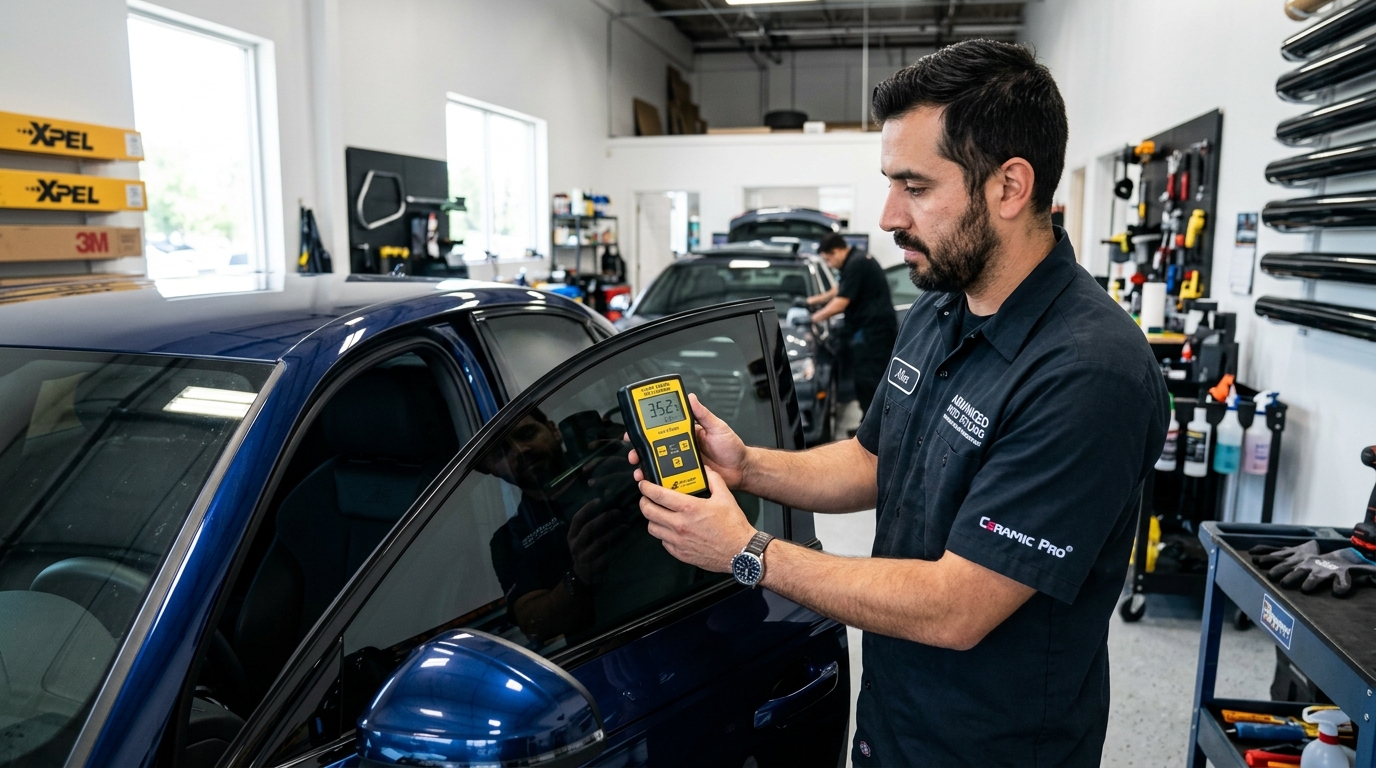
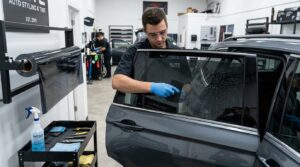
A reputable professional tint installer will measure the VLT of your factory glass on every window before cutting any film. This baseline measurement allows the installer to calculate exactly what combined VLT will result from any film added on top — and to advise you on which darkness levels are achievable within legal limits on your specific vehicle. Our guide to DIY versus professional window tinting covers this point in detail — the factory glass measurement step alone is a compelling reason why professional installation delivers outcomes that DIY cannot reliably replicate, regardless of the skill of the person applying the film.
Reflective Tint, Medical Exemptions, and Other Rules
Beyond the VLT percentages, BC’s tinting regulations include several additional requirements that are worth understanding before making any film selection.
Reflective tint is not permitted
BC law specifically prohibits tint films with higher than normal reflectivity. Mirror-finish or highly reflective tint — films that produce a one-way mirror effect from outside the vehicle — are not legal on any window in British Columbia. This prohibition exists for road safety reasons: highly reflective windows create glare for other drivers and pedestrians that can impair their visibility, particularly in low-sun morning and evening conditions. Standard dark tint films — including ceramic, carbon, and dyed films without metallic reflective coatings — are not affected by this rule. The prohibition applies specifically to films engineered to produce a reflective appearance.
No medical exemptions exist in BC
Unlike some Canadian provinces — Alberta, for example, offers an exemption pathway for drivers with documented UV sensitivity conditions — British Columbia has no medical exemption program for window tinting. Drivers with conditions requiring protection from UV radiation are not able to obtain authorization for darker-than-legal front window tint through a medical process. The only legal solution for UV protection on front windows in BC is a clear or near-clear UV-blocking film that complies with the 70% combined VLT requirement while still blocking the harmful ultraviolet radiation that causes skin damage.
No certificate or sticker required
BC does not require a compliance certificate or a tint sticker to be affixed to the window after installation — unlike some US jurisdictions where a certificate from the installer must be kept in the vehicle. Enforcement in BC is purely meter-based and visual: an officer uses a handheld photometer to measure VLT on the combined glass-and-film surface, and the reading either meets the legal threshold or it does not. The absence of a certificate requirement makes compliance entirely dependent on the accuracy of the installed VLT — which returns to the point about professional measurement being the foundation of any legally compliant installation.
Choosing the Right Film Within the Legal Limits
The VLT restrictions that BC law places on front windows do not mean that front-window tinting is pointless. The performance benefits of a clear or near-clear UV-blocking film on front windows are meaningful and real — they simply work through a different mechanism than visual darkening.
Clear UV films for front windows
High-performance ceramic films are available in VLT levels of 70% and above that still block up to 99% of UV radiation and reject a significant proportion of infrared heat. These films make front windows legally compliant while delivering the UV protection and heat reduction benefits that most BC drivers want from window tinting. The windows do not look visibly darker — the car’s appearance from outside is unchanged — but the driver and front passenger receive meaningful protection from UV-induced skin damage and meaningful reduction in solar heat entering the cabin.
Rear windows: where the performance choices open up
With no VLT restriction on rear side windows and the rear windshield, BC drivers have full freedom to choose high-performance dark films for the rear of the vehicle. A ceramic film at 20% VLT on rear windows delivers excellent privacy, significant heat rejection, and up to 99% UV blocking — all legally, on any BC-registered vehicle with the required external mirrors. For commercial vans and vehicles where privacy is a specific priority, our detailed guide to van window tinting for privacy and security covers how these unrestricted rear windows can be used to maximum effect.
Film type matters as much as darkness level
Within any given VLT percentage, the type of film technology determines how much heat rejection and UV blocking it delivers. Dyed films are the most affordable but provide the least heat rejection and fade over time. Carbon films are more durable, do not fade, and deliver meaningful heat rejection. Ceramic films are the premium choice — they deliver the highest heat rejection, the best UV blocking, and the longest service life, and they do not interfere with electronic devices including GPS, mobile phones, or any other technology operating inside the vehicle. For front windows where VLT must remain at 70% or above, investing in high-performance ceramic film ensures the maximum possible benefit is extracted from the limited darkening that BC law permits on those surfaces. For guidance on how professional installation compares to DIY across every aspect of the tinting process — not just legal compliance — our post on professional versus DIY window tinting covers the full picture.
What Happens If Your Tint Is Non-Compliant
Understanding the consequences of non-compliant tint in BC is a useful motivator for getting the installation right the first time. The practical risk is not theoretical — BC police officers routinely carry handheld tint meters and use them at traffic stops and vehicle inspection checkpoints.
Fines and removal orders
Non-compliant window tint in BC can result in a violation ticket with fines reaching $598 for the infraction. More significantly, an officer who determines that the tint is non-compliant can issue a vehicle inspection order requiring the tint to be assessed and — if confirmed as non-compliant — removed before the vehicle can be driven legally. The cost of removing a professionally installed tint job and having compliant film reinstalled is substantially higher than the cost of a correctly specified installation from the outset.
ICBC inspection implications
Non-compliant tint can also affect ICBC inspections. A vehicle presented for inspection with front-window tint below the 70% VLT threshold will not pass, and the tint removal and reinstallation process adds both time and expense to what should be a straightforward compliance check. For anyone planning a vehicle purchase, it is also worth noting that a used vehicle with non-compliant tint transfers that compliance problem to the new owner — who becomes responsible for bringing the vehicle into compliance regardless of what the previous owner installed.
The most straightforward way to avoid all of these outcomes is to work with a professional tint installer who measures your factory glass, calculates combined VLT accurately, and installs film that keeps every window on your vehicle within BC’s legal limits. ASC’s window tinting service covers the full range of film options — from clear UV-blocking films for front windows to high-performance ceramic dark films for rear applications — with professional measurement and installation that gives you the right result the first time. Get in touch to discuss the best tint setup for your specific vehicle and driving needs.