Why Car Owners Are Turning to 3D Printing for Interior Personalisation
Walk into a vehicle showroom today, and you will find a wall of pre-set options — a handful of trim colours, two or three upholstery grades, and a limited menu of technology packages. For most buyers, that level of choice is perfectly adequate. But for the driver who wants a cabin that feels genuinely personal, those factory menus fall frustratingly short.
That gap is exactly where 3D-printed custom interior trim is carving out a fast-growing niche. Once the exclusive territory of aerospace engineers and high-end motorsport teams, additive manufacturing — the process of building an object layer by layer from a digital file — has become accessible, affordable, and genuinely practical for automotive interior work. The result is a new generation of bespoke door panels, dashboard inserts, gear surrounds, centre console covers, and decorative trim pieces that could not exist through any conventional manufacturing route.
This is not a fringe movement. According to Global Market Insights, the global automotive 3D printing market was valued at USD 5.93 billion in 2025 and is projected to reach USD 23.19 billion by 2035 — a clear signal that the industry considers additive manufacturing a long-term structural shift, not a passing trend. Custom interiors and trim components sit right at the heart of that growth.
What Is 3D-Printed Interior Trim and How Does It Work?
3D-printed interior trim refers to any decorative or functional cabin component produced through additive manufacturing rather than conventional injection moulding, CNC routing, or vacuum forming. The process begins with a precise digital model — usually created in CAD software — which is then fed to a 3D printer that deposits or fuses material in successive layers until the finished part emerges.
The main printing technologies used in automotive interiors
Not all 3D printers work the same way, and the technology chosen has a significant bearing on the quality and finish of the final trim piece. The three most relevant processes for interior work are:
Fused Deposition Modelling (FDM) is the most widely accessible method. A spool of thermoplastic filament — typically ABS, ASA, or PETG — is melted and deposited in precise paths. FDM is well-suited to structural brackets, vent bezels, and mounting hardware where surface finish is less critical or where the part will be painted or wrapped afterward.
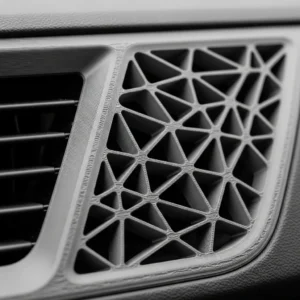
Selective Laser Sintering (SLS) uses a high-power laser to fuse powdered nylon or composite material into solid cross-sections. SLS produces parts with excellent dimensional accuracy and a consistent, slightly textured surface — ideal for complex geometric shapes, lattice structures, and decorative inserts that need to hold fine detail.
Stereolithography (SLA) and Digital Light Processing (DLP) work by curing liquid resin with ultraviolet light, layer by layer. These methods achieve the finest surface resolution of the three and are the preferred route for intricate decorative trim, instrument bezels, and any piece that will receive a high-gloss or transparent finish.
What materials can be used?
The range of printable materials has expanded dramatically. Modern interior trim can be produced in rigid polymers, flexible rubber-like TPU for gaiters and edge trims, nylon composites reinforced with carbon fibre or glass, and even metal via processes such as Direct Metal Laser Sintering (DMLS). Each material class brings different properties — rigidity, weight, heat resistance, texture — that can be matched precisely to the functional demands of the part being made. For custom trim and upholstery work, the choice of material is as important as the design itself.
The Real Advantages Over Traditional Trim Manufacturing
Understanding why 3D printing is gaining such traction in the custom interior world requires a direct comparison with the methods it is replacing.
No minimum order quantities
Injection moulding — the standard method for mass-produced interior trim — requires expensive steel tooling that can cost tens of thousands of dollars to produce. That tooling investment only makes financial sense when amortised across thousands of identical units. A single custom piece, or even a short run of ten, is simply not viable. 3D printing has no tooling costs whatsoever. The digital file is the tool. One piece costs no more per unit than a hundred pieces, which means truly one-off personalisation is now economically achievable.
Geometric freedom, unlike any other process
Injection moulding imposes strict design rules — no undercuts without sliding cores, no deep recesses, no internal voids. 3D printing ignores most of those constraints. A designer can specify a dashboard insert with internal channels, a honeycomb lattice that is both lightweight and rigid, or a surface texture of fractal complexity — and the printer will build it faithfully. This freedom unlocks aesthetic ideas that would be physically impossible, or prohibitively expensive, through any other method.
Faster iteration from concept to finished part
In a traditional trim development cycle, a design change means new tooling, which means weeks of lead time. With additive manufacturing, a revised digital file is printing overnight. A client can approve a physical prototype on Tuesday, request a modification on Wednesday, and have the corrected part in hand by Thursday. For auto styling professionals, this speed of iteration is transformative — it collapses the gap between imagination and reality.
Weight reduction
Because 3D-printed parts can incorporate internal lattice or hollow-shell structures rather than being solid throughout, they are frequently lighter than their moulded equivalents while retaining equivalent — or better — rigidity. For electric vehicle owners, every gram saved in non-structural interior components contributes marginally but measurably to range.
Interior Components That Benefit Most From 3D Printing
While theoretically any cabin component can be 3D-printed, certain parts deliver the most compelling return on the technology’s unique capabilities.
Dashboard trim inserts and bezels
The dashboard is the visual centrepiece of any interior. Factory trim inserts — wood-effect, piano black, brushed aluminium — are uniform and non-negotiable. A 3D-printed insert can be designed to the millimetre, finished in any colour or texture, and fitted to the existing mounting points without modification. Geometric patterns, personalised engravings, or material combinations (such as a carbon-nylon composite with embedded aluminium mesh) are all achievable.
Centre console surrounds and gear shift panels
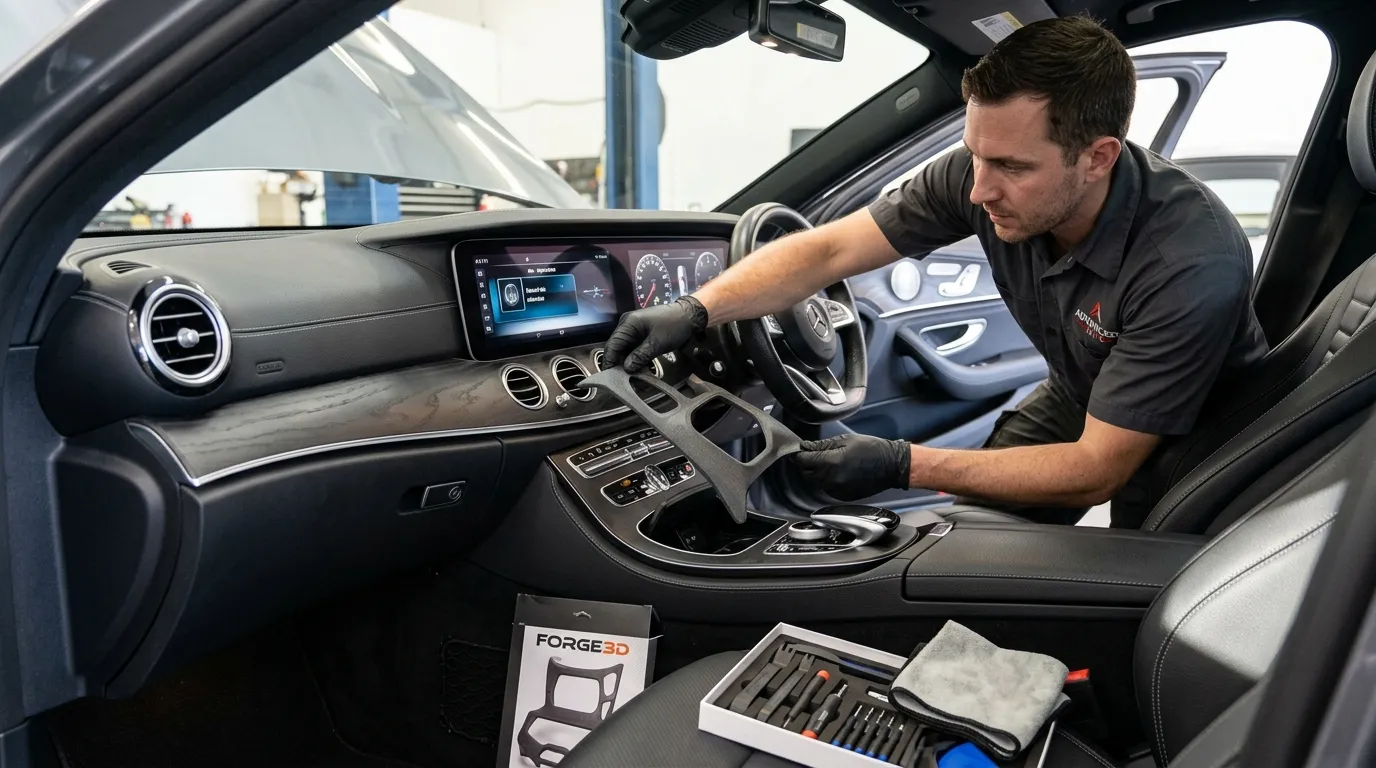
The centre console area receives constant tactile contact, making material selection important. Hard-wearing SLS nylon or carbon-composite prints perform well here, and the precision of additive manufacturing ensures a flush, rattle-free fit against adjacent OEM panels — something that poorly fitted aftermarket trim pieces often fail to achieve.
Door panel inserts and pull handles
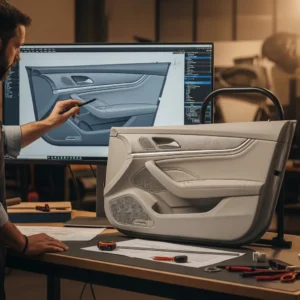
Door panels offer large surface areas for decorative expression. 3D-printed inserts can replace the fabric or vinyl-wrapped sections with custom geometric reliefs, speaker grille covers, or textured panels that match a chosen theme throughout the cabin. Combined with custom leather interior work, a 3D-printed door panel surround can anchor a fully bespoke aesthetic that reads as a cohesive design rather than a collection of aftermarket additions.
Air vent bezels and HVAC surrounds
Vent bezels are small, highly visible, and easily swapped — making them an ideal first project for anyone exploring custom 3D-printed trim. A set of precisely matched bezels in a distinctive finish can transform the perceived quality of an otherwise standard dashboard at relatively low cost.
Pedal covers, shift knobs, and small accessories
These components are frequently touched and highly personalised in the custom car community. 3D printing allows shapes, ergonomics, and surface textures to be designed around the driver’s hand specifically — a level of anthropometric customisation that no off-the-shelf part can replicate.
Design Considerations for Quality Results
The difference between a 3D-printed trim piece that looks premium and one that looks homemade usually comes down to three factors: design intent, material selection, and post-processing.
Wall thickness and structural integrity
Interior trim pieces must withstand vibration, temperature cycling between cold starts and hot summer days, and the incidental knocks of daily use. Designing parts with appropriate wall thicknesses — typically between 1.5 mm and 3 mm, depending on material — and incorporating ribbing or gussets where panels span large unsupported areas is essential for longevity.
Fit tolerances and OEM mounting points
A beautiful part that does not fit properly is a frustration, not an upgrade. Accurate measurement of the existing mounting points, panel gaps, and mating surfaces — and translating those measurements faithfully into the digital model — is the foundation of a professional result. Experienced auto styling technicians will scan or carefully measure the target area before modelling begins.
Surface finishing and painting
Most 3D-printed parts benefit from post-processing before they are considered truly finished. Sanding, priming, and painting FDM parts produces a surface indistinguishable from a moulded component. SLS nylon can be smoothed with vapour or chemical treatments. Resin prints from SLA or DLP emerge with near-injection-mould surface quality directly from the printer, requiring only a light sand and UV cure before painting or clear-coating. For an overview of how professionals approach surface preparation, Built In’s guide to 3D-printed car components offers useful context on how major manufacturers approach the finishing stage.
How 3D Printing Fits Into a Professional Auto Styling Workflow
For auto styling centres with the right expertise, 3D-printed trim is not a replacement for traditional craft skills — it is an extension of them. The design and printing stage produces a precise substrate; the skilled trimmer then integrates that component into the broader interior environment, ensuring panel alignment, hiding fasteners, and blending the new piece with upholstered surfaces, wiring, and adjacent OEM components.
At ASC, our trim and upholstery expertise spans decades of custom, restoration, and repair work across everything from daily drivers to classic cars and specialist vehicles. Adding 3D-printed components to that skillset means clients can bring a design vision of almost any complexity and have it realised as a finished, fitted, professional result — not a prototype sitting loosely in a door pocket.
Whether you are looking to refresh a tired interior with updated trim inserts, build a themed cabin from scratch, or restore a classic with accurately reproduced panels that are no longer available from OEM suppliers, the combination of additive manufacturing precision and traditional upholstery craft opens up possibilities that simply did not exist a few years ago. You can explore the full range of AI and technology-driven customisation approaches shaping modern auto styling, or browse the leather catalogues to see how premium upholstery materials can complement printed trim components.
The Road Ahead for 3D-Printed Automotive Interiors
The trajectory of additive manufacturing in the automotive sector points firmly upward. Materials science continues to deliver printable compounds with better heat resistance, greater flexibility, and more convincing surface aesthetics. Print speeds are rising while costs fall. And the emergence of multi-material printers — machines capable of laying down two or more materials in a single pass — means that soft-touch surfaces, rigid substrates, and flexible joints can all be produced as a single integrated component rather than assembled from separate parts.
Major manufacturers are already deep into this territory. BMW has used 3D printing for small-series interior components in its luxury range for years. General Motors has expanded additive manufacturing beyond prototyping into functional production parts on vehicles like the Cadillac CELESTIQ. These are not experiments — they are signals of where the mainstream is heading, and independent auto styling shops that develop this capability now will be well ahead of the curve when client demand catches up with the technology.
For the vehicle owner, the practical implication is straightforward: the interior of your car does not need to look like anyone else’s. If you can describe it, sketch it, or point to a reference, the tools now exist to build it — precisely, durably, and at a cost that makes bespoke personalisation genuinely accessible rather than the exclusive preserve of six-figure custom builds.
Ready to explore what custom trim work can do for your vehicle? Contact ASC’s trim and upholstery team to discuss your ideas and find out how we can bring them to life.