
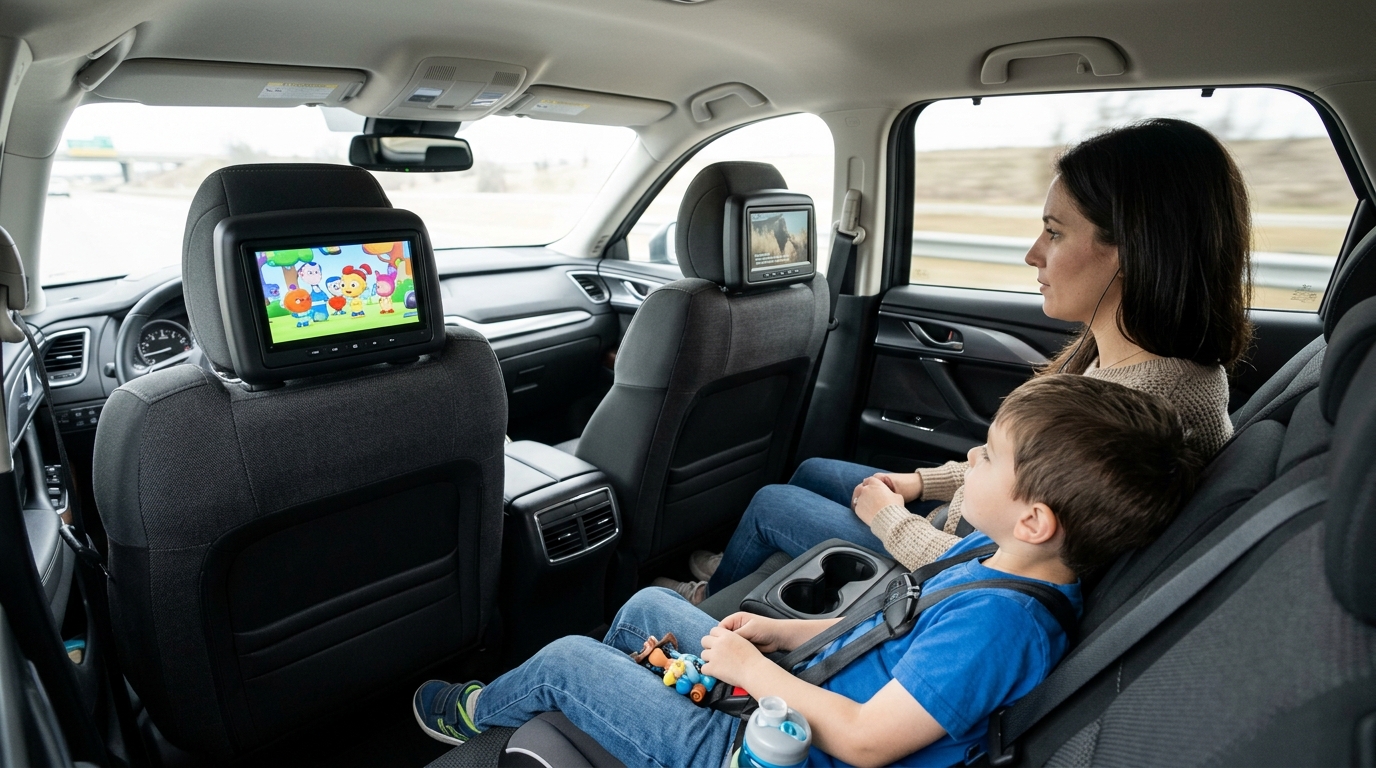
The Problem With Long Drives and Restless Passengers
Every parent, every driver who regularly carries passengers, and every owner of a vehicle used for anything beyond a solo commute knows the challenge: keeping rear-seat occupants engaged and comfortable during extended travel. The back seat of most vehicles — even well-equipped modern ones — offers precisely nothing for entertainment beyond a window view and whatever passengers can manage on their own phones. For young children who cannot hold devices for extended periods, for passengers who want a shared screen experience, or for anyone who simply wants the rear cabin to feel as considered as the front, the standard vehicle interior falls significantly short.
The solution is one that has been available through the aftermarket for over two decades and has evolved considerably in that time: a professionally installed mobile video system that transforms the rear cabin into a genuine entertainment environment. Headrest-mounted LCD screens, overhead flip-down monitors, and integrated dual-channel systems covering multiple rows give rear passengers an experience that matches what factory rear entertainment packages offer in luxury vehicles — at a fraction of the cost of purchasing a new vehicle with that equipment, and fitted into the vehicle you already own and want to keep.
As Kelley Blue Book defines in its automotive glossary, a rear entertainment system delivers media to second-row and third-row passengers and may include media players, ceiling or headrest-mounted displays, gaming hardware, and headphones — features that are popular factory options for minivans, SUVs, and vehicles regularly used for long trips, with aftermarket systems widely available for vehicles that did not come equipped from the factory. This guide covers everything you need to choose the right system for your vehicle, your passengers, and your usage pattern.
Why Factory Rear Entertainment Falls Short for Many Drivers
Factory rear entertainment systems are available on a range of minivans, SUVs, and premium vehicles — but their availability and cost create real limitations for a large number of drivers who want this feature.
Restricted to specific models and trim levels
Factory rear entertainment is typically reserved for higher trim levels or offered as an expensive optional package. Buyers who purchased a base or mid-range trim — often making a practical budget decision — find that the feature they now want was available, but at a price that would have significantly increased the purchase cost. Retrofitting a factory system, where that is even technically possible, is rarely practical. The aftermarket route delivers the same functional outcome at a controlled cost without requiring a vehicle change.
Technology that ages with the vehicle
Factory systems installed three to five years ago are already behind the current standard in screen resolution, media format support, and connectivity. A DVD-only system without USB, SD card, or streaming inputs reflects the technology of its production era, not the usage patterns of 2026. Aftermarket systems purchased today support current media formats, include modern input options, and deliver screen quality that matches contemporary expectations — providing a rear entertainment experience that is genuinely current rather than dated.
No factory option exists for the vehicle
Many vehicles — sedans, hatchbacks, older SUVs, commercial vehicles, and work trucks — were never offered with factory rear entertainment as an option at any trim level. For the owners of these vehicles who want to add the feature, the aftermarket is the only available path. The range of systems available covers a wide enough variety of form factors, sizes, and installation approaches to suit almost any vehicle architecture.
Overhead Flip-Down Roof Monitors
The overhead flip-down monitor — also called a roof-mount or ceiling-mounted screen — is the most widely visible mobile video option and the one that delivers the largest screen size in the cabin for a given budget. The unit is mounted to the headliner above the rear passenger area, with the screen folding down on a hinge mechanism when in use and storing flush against the ceiling when not needed.
Advent Widescreen Flip-Down Overhead DVD
The Advent overhead series offers widescreen flip-down DVD monitors in multiple sizes to suit different vehicle architectures and family requirements. The 10.2-inch model is the most popular choice — large enough to be clearly visible from the rear seats without dominating the headliner, and sized correctly for the cabin geometry of most family SUVs and minivans. For larger vehicles or families who prioritize the viewing experience above all else, a 12-inch model is available on pre-order. The Advent unit delivers a 16:9 widescreen format at 800 x 480 resolution on a high-quality TFT LCD panel, includes two wireless headphones and a remote control, and supports DVD, CD, MP3, DVD-R, and DVD-RW media. Integrated LED dome lighting means the unit also serves a functional cabin role when not in entertainment use. For families with gaming-age children, a model with integrated video games and a wireless game controller is available alongside the standard configuration.
Accele Vision 11″ Widescreen Overhead DVD
The Accele Vision overhead unit offers a slightly larger 11-inch display with an OE-design roof-mount profile, available in gray, tan, and black to match a range of interior color schemes. The built-in multimedia player supports DVD, MP3, and CD, and the unit includes an iPod dock, USB input, SD card reader, and built-in FM modulator with IR audio — providing a wider range of media source options than basic DVD-only units. An integrated games option is available as an additional feature. The 16:9 aspect ratio at 400 NIT brightness ensures clear visibility in variable cabin lighting conditions.
Headrest Monitor Systems
Headrest-mounted screens offer a fundamentally different viewing geometry from overhead monitors — each screen is positioned at approximately eye level for the rear-seat passenger directly behind it, delivering a more personal and immersive viewing experience than a shared overhead screen. They are also less visually obtrusive when folded into the headrest position, maintaining a near-factory interior appearance when not in active use.
Advent factory-matched headrest monitors
The Advent (Audiovox) factory-matched headrest system is the premium headrest option in ASC’s mobile video range, and its distinguishing feature is precisely what the name implies: the headrests are color and material matched to the existing seat upholstery, producing an installation that reads as a factory option rather than an aftermarket addition. Each headrest contains a 7-inch dual touchscreen LCD monitor with a built-in DVD player, adjustable viewing angle, USB port, SD card slot, MP3 auxiliary input, and AV input and output connections. Two dual-channel wireless fold-flat headphones are included, along with a unique 2-in-1 remote control and game controller that provides 32 built-in video games — including 24 two-player titles. The 16:9 screen format and custom color matching make this system the right choice for owners who want a complete rear entertainment solution that enhances rather than detracts from the interior aesthetic. For vehicles where the seats are also receiving a leather interior upgrade, coordinating the headrest system and the upholstery in the same project is a natural combination — our leather interior service works seamlessly alongside mobile video installations to deliver a cohesive result.
Accele/Zicom universal headrest DVD system
For drivers who want the functionality of headrest-integrated screens at a more accessible price point, the Accele/Zicom universal dual headrest DVD system provides a cost-effective alternative. Available in 7-inch and 9-inch widescreen configurations in tan, gray, and black, this system integrates dual DVD players into each monitor, allowing both rear passengers to watch the same content or — by connecting separate DVD sources — different content simultaneously. SD card and USB inputs provide media flexibility beyond physical discs, and the built-in FM wireless transmitter and IR headphone transmitter allow audio to be distributed to wireless headphones independently of the front audio system. The last-memory function resumes playback from the previous position after the vehicle is restarted, which is a practical benefit for passengers watching longer content across multi-segment journeys.
Choosing the Right System for Your Vehicle and Family
The right mobile video system depends on a combination of factors — vehicle type, passenger profile, the number of rear-seat rows to be served, and the priority balance between screen size, individual viewing, and budget.
SUVs and minivans with two or more rear rows
Larger vehicles with two or three rows of rear seating benefit most from a combination approach: an overhead flip-down monitor for the second row, visible to all passengers in that area, combined with the option to add individual headrest screens for third-row passengers who are positioned too far from the overhead unit to see it comfortably. This configuration serves the maximum number of passengers simultaneously without requiring every seat to have its own dedicated screen.
Sedans and smaller SUVs
For vehicles with a single rear row, the choice between an overhead monitor and headrest screens comes down to personal preference and viewing habits. An overhead monitor is a shared experience — both rear passengers see the same content simultaneously, which is ideal for family movie viewing. Headrest screens enable each passenger to watch different content independently, which suits families with different age groups and content preferences. The dual-channel capability of the Accele/Zicom system, where each monitor can play a separate DVD source, delivers this independent-viewing benefit even in a compact rear cabin.
Vehicles used for commercial passenger transport
Shuttle vans, taxi vehicles, and other commercial passenger carriers benefit significantly from rear entertainment as a differentiating comfort feature. An overhead monitor in a van configuration serves multiple passengers in a single installation, and the addition of window tinting — as covered in our guide to van window tinting for privacy and security — creates a more comfortable and private viewing environment for passengers in commercial transport contexts.
Professional Installation: Why It Makes the Difference
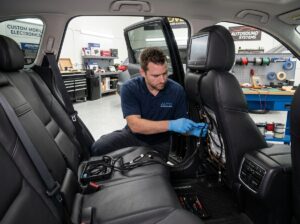
Mobile video systems can be purchased as consumer-grade units with basic mounting hardware, but the difference between a self-installed unit and a professionally installed one is visible every time someone looks at the vehicle’s rear cabin — and felt every time the system is used.
Color matching and headliner integration
The most significant aesthetic difference between professional and DIY mobile video installation is how the unit integrates with the vehicle’s existing interior surfaces. A professionally installed overhead monitor is fitted with mounting hardware specific to the vehicle’s headliner structure, positioned correctly relative to the rear seating geometry, and surrounded by trim pieces that match the headliner material and color. An aftermarket unit simply bolted to the headliner without vehicle-specific mounting creates a gap-filled, imprecise fit that immediately reads as an add-on rather than a feature. For the factory-matched Advent headrest system, professional installation is the only way to achieve the custom color and material match that makes the system indistinguishable from a factory-fitted option.
Wiring and power integration
Mobile video systems require a clean, permanent power connection routed through the vehicle’s electrical system — not through a 12V adapter in the center console. Professional installation routes the power wiring through the vehicle’s pillar trim and headliner, connects to the fuse box with the correct amperage protection, and manages all signal cables within the vehicle’s existing wiring channels. The result is a system with no visible cables in the cabin, a permanently powered connection that activates with the ignition, and wiring that does not create interference with other vehicle electronics.
Combining mobile video with other electronics upgrades
A mobile video installation appointment is the natural time to address related electronics improvements that benefit from the same level of access to the vehicle’s interior. Navigation and head unit upgrades at the front of the cabin, combined with rear entertainment at the back, deliver a comprehensive in-vehicle media environment in a single visit. For families also considering seat comfort upgrades such as heated or ventilated rear seats, combining that work with the headrest monitor installation minimizes the total disassembly and reassembly required and reduces the overall time the vehicle spends in the shop.
Our full range of mobile video systems — from the Advent widescreen overhead DVD to the factory-matched dual headrest monitors — is available through ASC’s electronics team, with professional installation included as part of every system purchase. Visit our car electronics page to explore the complete range of in-vehicle entertainment, navigation, and convenience upgrades currently available — or contact us directly to discuss the right configuration for your specific vehicle and the passengers who ride in it.